

Mi Tri is from an Indigenous village nestled in the remote mountains of Myanmar, where fruit trees blossom and sea cascade down from the hilltops. There, Mi Tri learnt from a young age about the importance of preserving nature and protecting the environment.
As an adult, when she heard about plans to construct a coal-fired power plant near her village, she wasn’t sure what this would entail at first.
“Companies want to build a coal-fired power plant,” she said. “People told us that if we let them do this, they’ll give us schools, hospitals, electricity, better roads,” Mi Tri explained. She suspected, however, that things might not have been quite as simple as they seemed.
After local civil society groups visited her village, Mi Tri and other residents began to understand the profound environmental and social risks behind these promises. “The project doesn’t mean development for my community. It would destroy the community,” she said. “It would impact the environment.”
Eventually, Mi Tri’s community refused to sell land and blocked entry to company representatives. Before the 2021 coup, the project was halted. But even today, the threat that the project might go ahead remains. “If you speak out, you can be arrested. So we need to stay quiet and think about how to solve the problem.”
From a Remote Village to the EarthRights School in Chiang Mai
As members of her community were starting to organize against the construction of the coal-fired power plant in 2014, Mi Tri made contact with a recent graduate of the EarthRights School program who lived close to her in Myanmar. The graduate told her about the program and encouraged her to apply.
In her village, there was no internet access, and the phone signal was intermittent. She knew that she would have to go to great lengths to send in her application; however, this only motivated her more.
She filled out a printed application form by hand. Then came the hard part: getting it submitted.
“I had to take a five-hour bus to the township to submit the application at an internet shop. I even had to stay there overnight,” she said. She recalls how the internet was very slow, and how it kept freezing right up until the deadline. But just a few minutes before, it finally worked, and her application miraculously went through.
Her phone rang one day, and EarthRights staff informed her that she had been selected for an interview. Shortly after, she received the news that she had been accepted to the program.
Finding Her Voice at the EarthRights School
Mi Tri travelled to Chiang Mai in 2015 to join the EarthRights School Myanmar program. This program, specifically designed for community organisers, activists, and defenders from Myanmar, provided participants with tools and strategies to defend their rights adapted to the particular in-country context.
The EarthRights School offers a unique blend of education in human rights, environmental law, and community advocacy, as part of a residential program lasting seven months in the Mitharsuu Center, Chiang Mai, Thailand. The program combines interactive classroom learning with field research to ensure that students put the tools they are learning immediately into practice.
“Before I attended the school, I felt less confident, and after the school, I really changed,” she said. “I had way more confidence to speak about my community, about our rights, and I knew then what kind of rights we have.”
The program’s emphasis on practical learning through field trips and critical thinking was transformative for Mi Tri.
“When we travelled to the field trip, we had to write an essay afterwards. In Myanmar, you normally don’t get a chance to speak, ask questions,” she said. “When I arrived, the school opened my mind and ideas, that kind of critical thinking was really amazing for me.”
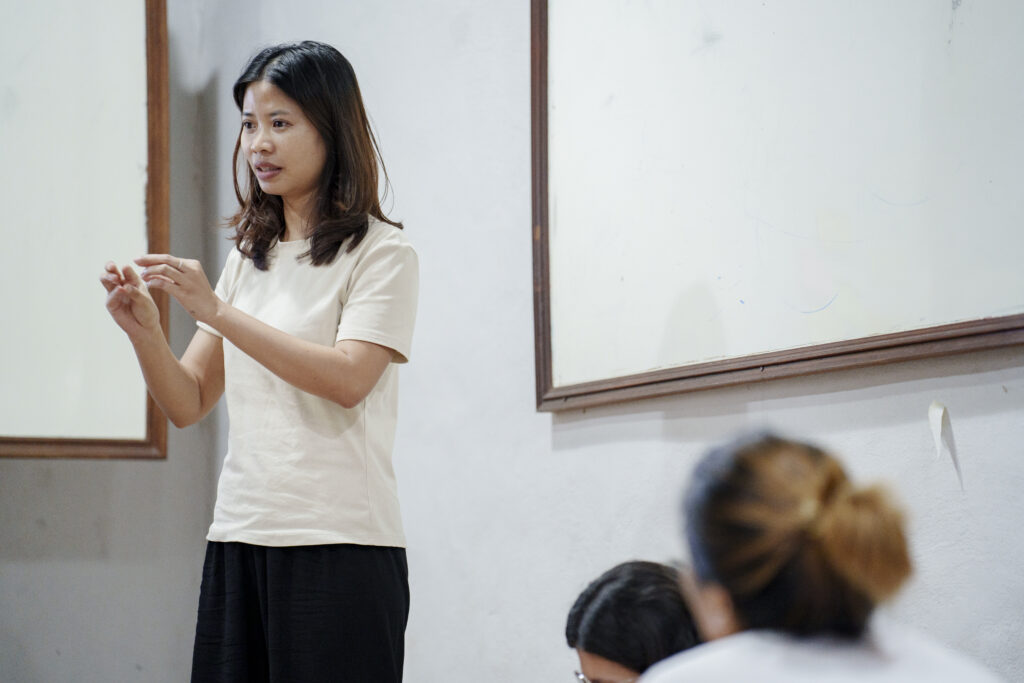
Becoming a Leader in the Alumni Network
Since participating in the school, Mi Tri’s country of origin has profoundly changed, along with her work. In 2021, a violent coup d’etat occurred in Myanmar, and the result was a takeover by the military junta. Since the coup, the military junta government has killed over 6000 people and has arbitrarily detained over 20,000. This new backdrop of violent repression has created unique challenges for communities standing up for their rights and the environment.
Mi Tri was not deterred, however. In 2024, Mi Tri joined the EarthRights Alumni Network as a Myanmar alumni representative, supporting young defenders to connect to alumni from other countries and build cross-border support networks.
“Before the coup, the Myanmar alumni network was very strong,” Mi Tri said. “After the coup, the alumni network changed because of the situation in the country.”
Her first task after joining the Alumni Network was to rebuild trust and community in a time of fear. “We had to do trust building with the alumni group. We had to connect with them, make communication with them, understand what they’re doing,” she said. “Safety and trust building is really necessary in Myanmar. Without this, our students cannot engage with us.”
This work has energized her, as has hearing the positive feedback she has received from alumni from Myanmar. “Alumni tell us that we’re like a second home for them,” she said. “I can learn so much from them.”
Stepping Onto a Regional Stage
Mi Tri’s growing leadership recently took her beyond Myanmar. Working with EarthRights staff across the Mekong region, she helped organize a workshop for the Mekong ASEAN Environmental Week on data analysis of environmental impacts.
“It was the first time I did this, and it was nice to see that I could do this,” she said.
Workshop participants came from Myanmar, Thailand, Laos, and Vietnam. She showed them how data and evidence can strengthen advocacy strategies. In this space, she was able to pass on knowledge she once learned as a student to others.
This experience confirmed something she already felt deeply.
“I feel proud to be an alumni,” she said. “Everything I learned had a big impact on me and also on my community. Other community members from my area now see my work, they call me to collaborate on a lot of new projects that I hadn’t worked on before.”
From a remote village with no internet connection to an international environmental forum, Mi Tri’s journey embodies the resilience of Myanmar’s communities. It also embodies the power of education, courage, and collective action.