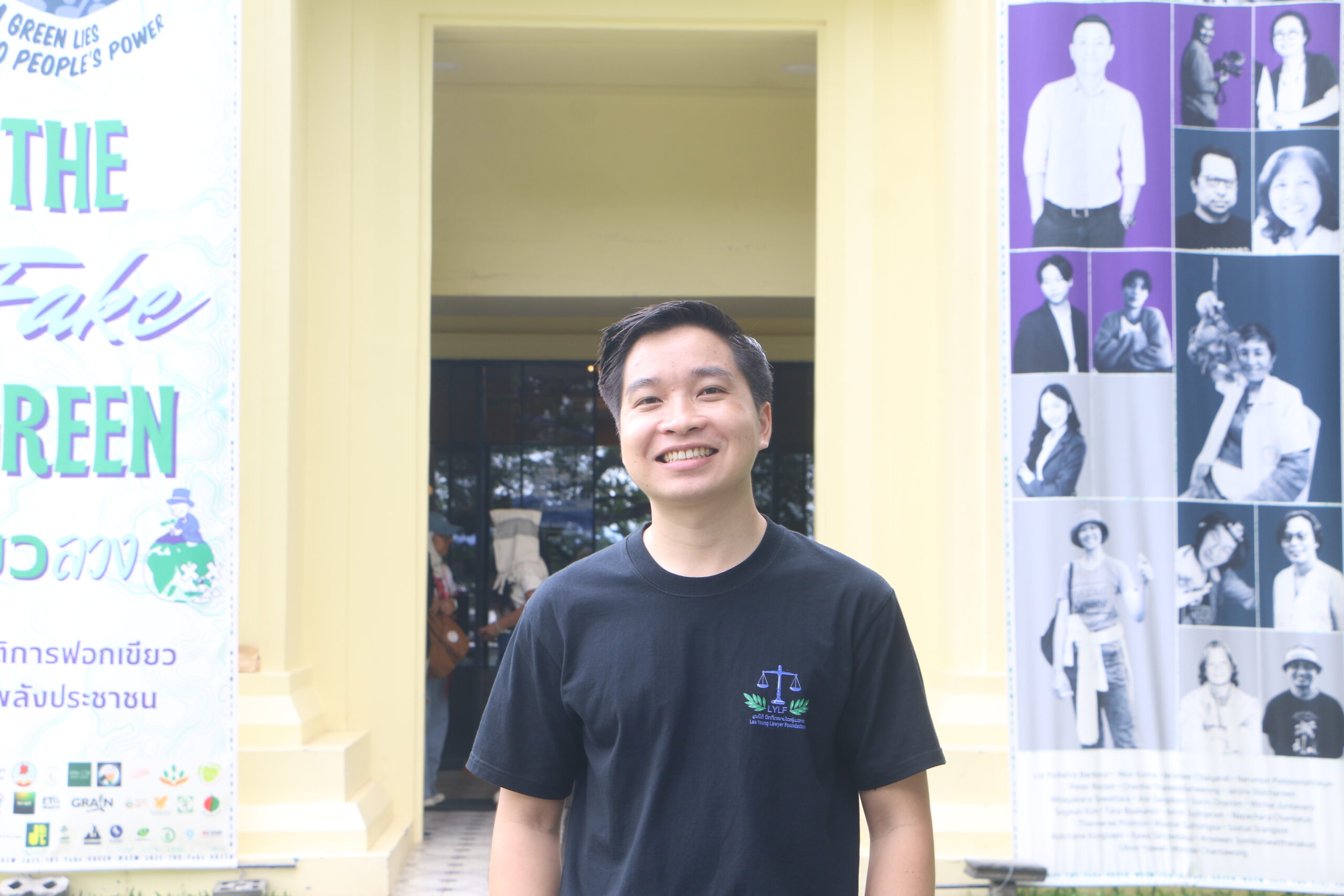
When Pay thinks about his home in northern Laos, his thoughts immediately drift to the land that has safeguarded communities like his for generations. For him, it is not just a place of belonging, but the center of every struggle his community faces.
“In my community, I work closely with the land. The problems we face are mostly related to the land,” he said.
Those problems have escalated in recent years. The government of Laos has been pursuing rapid development through harmful projects and the exploitation of natural resources, such as special economic zones, rare earth mining projects and large-scale land concessions to investors.
The consequences, Pay said, have been devastating. “In my home town, there are more than 30 villages that suffer effects from chemicals, the chemicals spill from rare earth mining into the river, and the community can’t use water for farming anymore.”
In addition to these threats, carbon credit schemes through the REDD+ mechanism are viewed as a government policy to encourage people to protect forests in order to offset their emissions. These programs focus on forest conservation, biodiversity protection, and sustainable use of natural resources, it is unclear how the benefits will be shared with local communities. These benefits are not clearly stated in government laws or regulations. These programs also often result in abuses such as land grabs and forest management systems that disregard the rights of indigenous communities.
Pay is a law graduate who works as a senior trainer with the Land Learning Initiative for Food Security Enhancement, a local NGO in Laos. He has participated in the Mekong Legal Advocacy Institute (MLAI) and the EarthRights School training programs, and is currently an active member of the EarthRights International Alumni Network, representing graduates from Laos.
Through his participation in these programs and his community work, he has found his voice.
A Transformative Journey to Defend the Environment
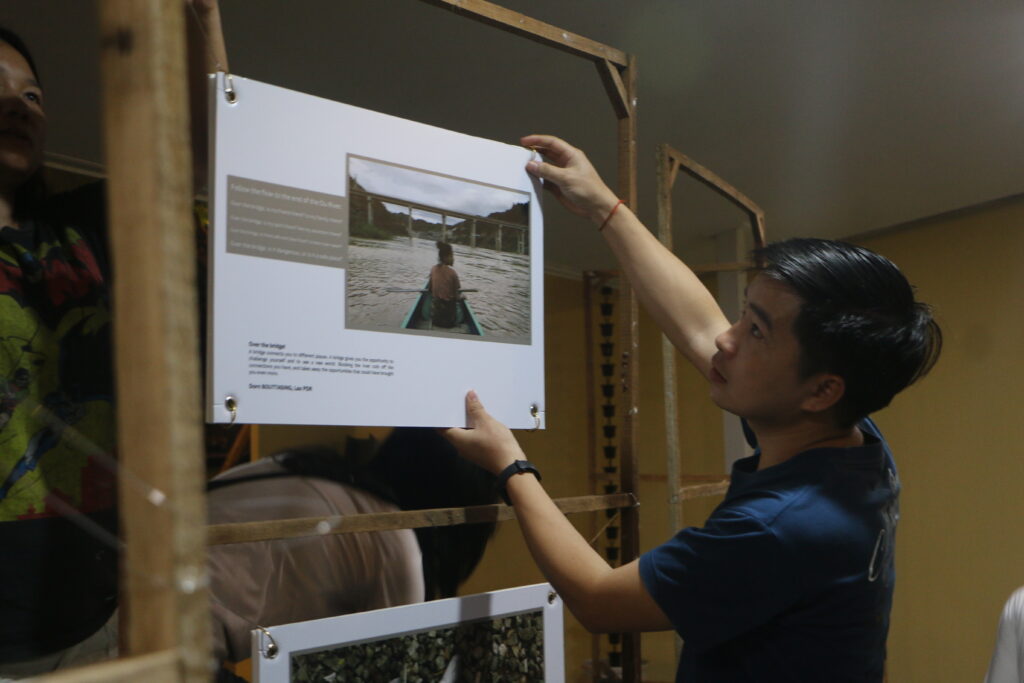
Pay first found out about EarthRights through his work colleagues, who began telling him about their experience participating in the MLAI program years earlier. He immediately felt interested and sent off his application form.
After he was selected, he arrived at the Mitharsuu Center in Chiang Mai, where he would participate in the intensive training program with other lawyers from across the Mekong region. At first, he was nervous, but he quickly found support from EarthRights staff and from his colleagues.
“I arrived and felt excited but scared because my English wasn’t so good. But there, they made me feel really comfortable to speak out,” he explained. “I promised myself that I would come back later to join the Earthrights School program.”
The experience transformed his understanding of community-centered advocacy and how he can use legal tools to advocate for the environment and human rights in Laos. “They have a safe environment so I could learn from the program,” he said. “We explored things like women’s rights, how to work with local communities. This gave me motivation to continue working with land rights and to provide support to communities in Laos.”
In 2023, Pay joined the EarthRights School, deepening both his technical knowledge and his networks. “It was really important for me. It taught me that the best way to support a community is to empower them through information,” he said.
Both training programs helped him understand the regional nature of the issues which many communities in Laos are facing. One thing that particularly struck him was learning about hydroelectric projects, and how they have created negative impacts across the Mekong region. “Dams are really impacting my country and communities. We need to collaborate more on a regional level to understand these impacts.”
The hands-on nature of the programs shaped his approach to community work. “It’s not just classroom learning, you learn through doing so learning feels easy,” he said. After completing both programs, he felt prepared to take on bigger challenges.
He returned to his community in Laos where he continues working with communities to train them about their legal rights and how they can use legal tools to defend their rights.
Carbon Credit Schemes in Laos That Threaten Rights of Communities
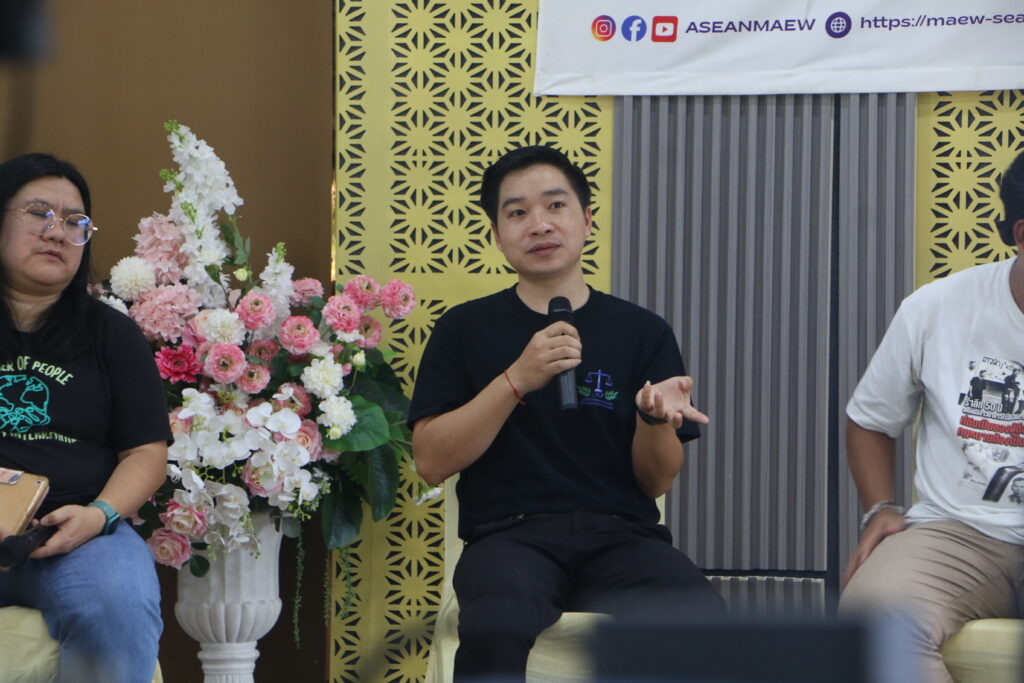
As a member of the EarthRights Alumni Network, Pay participated in a panel on “Challenging Green Grabs” at the Mekong ASEAN Environmental Week. During this event, he discussed current forest policy in Laos, village forest management systems, and the growing concerns around carbon credit programs and rare earth mining.
For Pay, it is fundamental to address the impacts of carbon credit programs in his country and across the Mekong region, given their recent expansion and their growing appeal as a way for companies to offset their carbon emissions.
These initiatives are often marketed as tools for conservation and sustainable development. Pay warned that the reality is more complicated. “The government thinks carbon credit programs will support communities in Laos, but I think communities should meaningfully participate in decision-making processes that recognize their rights. They should also fully understand the benefits and risks of the project,” he said.
The policies behind carbon credits, he explained, do not clearly define how community rights should be protected. “The local communities should protect the forests, and they will receive benefits. But in the law, they don’t mention how communities can participate in decision-making processes related to carbon credit programs. They also don’t mention explicitly how communities will actually benefit from these projects.”
A Future Where Collaboration Leads to Improved Solutions
For Pay, such gaps highlight why transnational collaboration is essential. Through the EarthRights Alumni Network, Pay has connected with other graduates from Thailand and Laos on the impacts of carbon credit schemes. He has also discussed other transnational issues such as rare earth mining, hydroelectric power projects, and land rights with his colleagues.
“It’s important for us to work on rare earth mining together. In Laos, we don’t have a lot of experience with this so we’re coordinating with alumni from other countries to support each other about documenting mining and combating negative impacts,” he said.
Today, Pay is encouraging a new generation to take action in defense of the environment. “Other people who work with communities in Laos could benefit a lot from the program; it could help to improve their knowledge, to develop their skills, and to help them improve their work,” he said. “I would love to support them to share how we work and what the local issues are that we’re facing in Laos.”
For him, the mission is personal and urgent. As land pressures increase and new forms of “green” exploitation emerge, he hopes regional solidarity will be the key to protecting the communities he grew up with.