
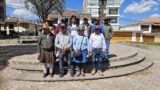
Tan grew up in Mae Hong Son province, in northern Thailand, as part of a Karen Indigenous community that has lived in harmony with nature for generations. 

Today, he lives in Chiang Mai, where he works with the Northern Development Foundation, a nonprofit organization supporting ethnic groups and farmers in rural and forest areas across Thailand.

In his role at the foundation, Tan advocates for policy changes that favor the preservation of Indigenous culture and rights in Thailand. He also works with specific groups impacted by threats, such as Indigenous farmers who practice traditional rotational farming, to make them aware of how they can respond to policies that negatively affect them. 

He works with Indigenous communities that face mounting restrictions due to forest conservation laws that limit the areas in which they can live and prohibit the use of certain natural resources on ancestral land. These laws are based on the idea that Indigenous and local communities do not possess the knowledge and capacity to manage their ancestral land or natural resources. It therefore restricts interactions that they can have with the land and centralizes natural resource management as a state function.

“The main issue across Indigenous communities in Thailand is the right to manage community resources, as well as land rights,” Tan said. “Indigenous communities in Thailand have been living in the forest long before laws were issued. However, these laws do not officially recognize indigenous people’s rights to be there.”

Forest Conservation at the Expense of Ancestral Communities

On 15 November 2024, the Thai Cabinet approved two Royal Decrees intended to address land-use conflicts in Conservative forest areas. Although presented as conservation measures consistent with the National Park Act and the Wildlife Preservation and Protection Act, the decrees in practice restricted the rights of Indigenous and local communities to their ancestral territories.

For more than 3,000 Indigenous communities nationwide, the measures resulted in increased limits on their role in natural resource management and a growing risk of displacement.

“First, the law does not allow traditional ways of living, such as rotational farming, Tan said. “Second, Indigenous people are restricted from managing their own community resources.”

Tan’s work focuses on both policy advocacy and grassroots empowerment. He collaborates with communities, academics and civil society groups to push for structural reforms.

“A successful case of my work involved collaborating with NGOs, academics, and others to advocate for the first law protecting and promoting the rights of ethnic groups and Indigenous Peoples in Thailand,” he said.

At the same time, he works directly with ethnic farmers to strengthen their capacity to organize as a community. “The work focuses on building and strengthening local movements so that communities are aware of their rights and have the capacity to respond to and resist policies that negatively affect them,” he said.

Strengthening His Understanding of Human Rights 

Tan participated in the EarthRights School program in 2021, alongside other defenders and advocates from across the Mekong region. He first completed online coursework during the pandemic and later spent five and a half months in person at the Mitharsuu Center with his colleagues.

“I learned about fundamental human rights principles, especially the rights every person is entitled to from birth,” he said.

The program deepened his understanding of international human rights standards and the mechanisms that exist to protect the rights of defenders and communities. “Thai laws have limitations and, in some cases, conflict with human rights principles, particularly the United Nations Declaration on the Rights of Indigenous Peoples (UNDRIP),” Tan said. “At EarthRights School, the teachers explained UNDRIP in depth, and I realized that nothing is more important.”

Beyond legal frameworks, the EarthRights School program emphasized applied learning through exercises that allow students to put their knowledge into practice. “Combined with field practicum addressing real environmental and human rights issues, I gained experience in collecting community-level data for further analysis, negotiation, and presenting real-life impacts,” Tan said.

The Alumni Network and the Mekong ASEAN Environmental Week

After graduating, Tan became an active member of the EarthRights Alumni Network, including the Thai Alumni Network group, in which he communicates and collaborates with other graduates from across Thailand. 

For Tan, the Alumni Network reinforces the importance of collective action. “It is important to support each other to create a bigger movement,” he said.

In September 2025, with support of the Alumni Network, Tan brought his experience to the Mekong ASEAN Environmental Week as a panel speaker on “Challenging Green Grabs”. 

The panel addressed how conservation and climate initiatives in Thailand can mask land grabbing from communities that have inhabited the land for generations. “The struggles in Thailand and Laos often intersect with environmental initiatives marketed as climate solutions,” Tan said.

For Tan, sharing his experience through events and panel discussions is part of a broader commitment to promote the defense of the rights of indigenous people. “I wanted to share my knowledge, skills, and experience gained from the EarthRights training programs with the public because it could be helpful for the work of other environmental human rights defenders,” he said.

Looking ahead, Tan sees EarthRights as a lasting source of solidarity. Through the networks he made with others, he knows that his fight for environmental justice will only grow stronger. 

“EarthRights School and the EarthRights Alumni Network not only create a chance to connect with others, but they also create spaces where defenders know they always have allies fighting for the same issues, both now and in the future,” he said.