
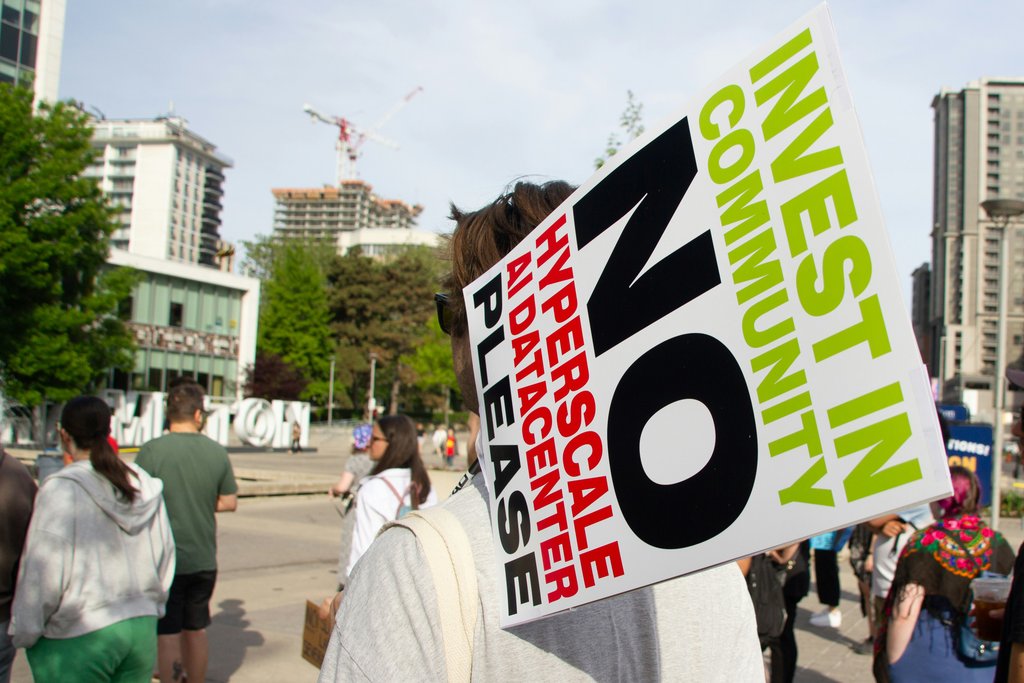
Despite millions spent in public relations campaigns, tech companies have struggled to win broad public approval for their rapid buildup of artificial intelligence (AI) infrastructure, with a Gallup poll finding that 7 in 10 Americans oppose AI data center construction in their neighborhood. Numerous communities have raised concerns that these massive projects – which can span hundreds of acres of land – consume huge amounts of electricity and water, drive up the cost of living, and generate air, noise, and light pollution. While some AI data center developers have responded by engaging in good faith with local communities, others have resorted to the same tactics that the fossil fuel industry has long deployed to bypass local opposition to oil and gas pipeline projects.
| What you need to know: |
|---|
| * A recent poll found that 7/10 Americans would oppose AI data center construction in their neighborhood — but that hasn’t stopped them from being built. * The fossil fuel industry has routinely undermined local community decision-making processes to build oil and gas projects. Some data center developers are doing the same. * Fossil fuel companies are some of the biggest spenders on lobbying and PR campaigns to influence legislators and the public. Now, the data center industry is spending millions on public relations, lobbying, and political action committees to improve the public’s opinion and make it easier to build more data centers. Public relations, however, is not the same as good faith community engagement. * In some areas, opposition to data centers is being criminalized: law enforcement in Pennsylvania has called anti-AI protesters “anti-tech extremists,” and communities speaking out have been monitored by police. Some national politicians have used similar rhetoric, accusing community leaders of being Chinese agents and calling for investigations. * Similar narratives have been used by the fossil fuel industry to portray protesters and opposition as criminals, or foreign agents. The industry has also pushed for the criminalization of protesters and disproportionately harsh punishments. * Unless the data center industry shifts to more responsible community engagement practices, we can expect growing pushback and loss of social license to operate. |
Taking a page out of the fossil fuel industry’s playbook
The fossil fuel industry has a history of undermining community participation in order to build out oil and gas development. Rather than engage with local communities in good faith to reach win-win arrangements, the fossil fuel industry has often turned to anti-democracy practices, such as (1) spreading misinformation about the local costs and benefits of a proposed project, (2) sidestepping procedures that allow communities to raise concerns about a proposed project, (3) intimidating and harassing project opponents and critics, and (4) capturing or stripping away local government powers.
We are seeing similar tactics appear in some AI data center projects, but it is not too late for the industry to shift towards a responsible approach that puts communities’ rights front and center.
Spreading misinformation about the project’s costs and benefits
Tech companies are aware of the growing opposition to data center development, and many seem to be turning to the public relations industry for help. For example, Meta (the parent company of Facebook and Instagram) reportedly spent over $6 million in a public relation blitz in late 2025 targeting eight state capitals and Washington, DC.
AI data center developers have also offered headline-grabbing payouts to communities and local governments to accept their projects. In October 2026, Amazon pledged to end nondisclosure agreement (NDA) requirements with government agencies and to spend more than $1 billion across five years in communities as a response to growing community opposition and over 100 data center moratoriums introduced across the US.
While these are welcome steps towards more honest engagement with communities, there are many examples of public relations efforts not leading to the kind of good faith community engagement that is needed at this moment. Public relations can go astray when developers:
- Misinform communities about the project’s benefits and impacts: A report from Brookings Institution found that data centers create fewer jobs than developers promise, while the industry’s claims that data centers do not drive up utilities costs have been criticized by experts as misleading. The Guardian reported that in Tucson, Arizona, a proposed data center claimed that it would be “water positive.” However, an aquatic ecologist and Tucson resident found that the data center would do so by making “water positivity” payments for using more groundwater than can be replenished, making up for usage on paper only.
- Co-opt the language and tools that communities are using to advocate for their rights: Many communities that are open to data centers have negotiated “community benefit agreements” (CBAs), which are legally binding contracts to ensure that developers keep their promises to communities in exchange for receiving approvals. However, some data center developers have responded by negotiating secret deals without meaningful community input and then simply labeling these agreements “CBAs.” For example, in Swatara Township, Pennsylvania, a $120 million “CBA” was approved by local officials the same day the agreement was shared with constituents. Despite the community asking for a delay to read through the contract, officials voted 4-1 to approve it, with the commissioner president expressing concerns that a delay could lead to developers revoking the offer.
- Break promises once the permits are given: In other cases, AI data developers fail to comply with the commitments made during the permitting process. For example, Politico reported that a developer in Georgia used 29 million gallons of water, going beyond the peak level of water use agreed to with Fayette County, according to a letter from the Fayette County Water System.
Sidestepping procedures that give a community a voice in development decisions
The fossil fuel industry has a long history of lobbying to restrict people’s ability to have a voice in whether proposed projects can pass through their communities. Likewise, many data center developers have lobbied for similar restrictions. These developers seek to:
- Speed up approval processes by eliminating opportunities for public participation: Data center proponents are lobbying to speed up approval processes by restricting communities’ opportunities to raise concerns about projects. Donald Trump’s Environmental Protection Agency has proposed eliminating public comments for industrial projects, including data center projects, during the Clean Air Act permitting process. In other cases, projects are voted on at the same time they are announced, giving no time for review. KTSM reported that officials and communities in Hudspeth County, Texas were not even informed of a nearby data center development until after construction had already started. The New York Times reported on the proposed fast-tracking of 82 natural gas plant permits to fuel data centers in the U.S. At least 15 projects, all in Texas, have already received approval for fast-tracks that allow them to skip public comment periods through which communities can voice their concerns about the impacts of a project.
- Prevent local officials from sharing information with their constituents: Secrecy in negotiations between developers and public officials through the use of NDAs has also led to project approvals without community support. For example, WWLTV reported that Meta entered into NDAs with the Louisiana Board of Economic Development, as well as city and state officials. These NDAs appear to have restricted what Louisianans were told about the massive, 5 gigawatt, $50 billion data center. Similarly, in the case of Amazon’s $12 billion Shreveport, Louisiana data center, local media reported that residents only learned details after the deal was struck due to NDA use. This practice has become increasingly commonplace: in Virginia, which has more data centers than any other state, a report from Public Citizen found that 80% of communities’ local officials have signed NDAs with existing or proposed data center developers.
Intimidating and harassing project opponents and critics
Security is a concern in any large infrastructure project. However, some fossil fuel companies – especially those that build oil and gas pipelines – have a track record of using security strategies that encourage local and federal law enforcement to treat opposition to the projects, such as protesters, as if they are criminals or terrorists. Some of these same patterns are now appearing in data center projects, where developers:
- Use private security firms to deploy militarized tactics against project opposition: In response to protests against the Dakota Access Pipeline in 2016, a private security contractor allegedly used counter-terrorism and counter-insurgency tactics against the protesters, who the contractor compared to “jihadists.” Similarly, The American Prospect reported that private security and intelligence firms are now compiling trend and threat assessments on AI data center opposition and selling them to federal regulators.
- Co-opt local law enforcement through financial incentives: Some fossil fuel companies have entered into financial arrangements with local law enforcement agencies that lead police officers to act as private security for the company and to engage in discriminatory policing against protesters. For example, in Louisiana, numerous reporters have alleged that public law enforcement officers were hired to moonlight as private security for Energy Transfer’s Bayou Bridge pipeline, leading to incidents in which protestors were arrested by off-duty officers working security for the company. Now, it looks like at least one data center developer might be doing the same. In Richland Parish, Louisiana, Meta is building its largest data center project, nicknamed “Hyperion.” The New York Times reported that Meta hired off-duty sheriff’s officers to monitor roads in the mostly rural county during construction of the $50 billion data center.
- Co-opt federal counter-terrorism infrastructure: Federal counter-terrorism fusion centers – which seek to foster coordination between federal, state, local officials, and other stakeholders, often including private sector companies – have often pursued narratives depicting protesters of fossil fuel projects as “domestic terrorists.” Now, in a similar vein, the Trump administration has equated “anti-tech extremism” with domestic terrorism and has characterized opposition to data centers as a national security threat. Fusion centers have also reportedly monitored demonstrations in Northern Virginia, including at county budget meetings. A Philadelphia-based fusion center confirmed they are monitoring social media posts of data center opponents.
Capturing or stripping away local government powers
When fossil fuel companies have encountered local government opposition to their proposed projects, many have responded by suing local governments (which may lack the funding to defend against a lawsuit from a multi-billion-dollar corporation) or by lobbying state or federal governments to preempt the local government’s powers. Some data center developers appear to be using similarly heavy-handed tactics:
- Sue under-resourced local governments that push back on proposed projects: In Michigan, for example, the OpenAI and Oracle-backed “Stargate” data center project is reportedly moving forward even after the town board voted to reject it. While OpenAI has a comprehensive pledge to work with “Stargate” communities, Inside Climate News reported that Related Digital, the project developer, sued the town of less than 3,000 and received approval as part of a settlement. A local reporting project identified at least four New Jersey communities where developers sued local governments for instituting data center bans.
- Preempt local governments from having oversight over data centers: Local governments and communities are also having their rights stripped from them through state and federal legislation that preempts the local approval process for data centers. Preemption in this context means that a higher authority displaces a lower authority of law; in this case, state and federal laws supersede municipal and county governments. West Virginia passed a bill in 2025 exempting information deemed confidential by data centers from Freedom of Information Act requests, and preventing local governments from enforcing data center laws. At least nine more states have bills in their legislature that aim to restrict local governments and communities from having a say on whether AI data centers are built.
- “Segment” projects during permit approvals to avoid oversight: Developers have attempted to split up construction of a data center into several phases, each of which receives a separate permit – a tactic known as “segmenting” that is frequently used by the fossil fuel industry. Segmentation has been used as a way to portray the environmental and health impacts of a project as less severe than they are in reality, because each permitting stage only examines a portion of the overall project. The New York Times reported that Meta’s Texas hyperscale data center is segmenting its project into separate phases, with its first phase receiving approval in just 20 days for 366 megawatts produced by 800 small gas generators. Another data center with a capacity of two gigawatts, enough to power 1.5 million homes, is segmenting its power project into eight phases. In response, the Environmental Integrity Project, Sierra Club, and Public Citizen have sued the developers.
The need to shift from a “public relations” to a “community engagement” mindset
Many Americans across the political spectrum are angry and nervous about the AI data center boom. Lawmakers have proposed legislation at every level of government to regulate or ban their construction, and require them to pay for the true cost of their resource use. People have taken to town halls to voice their opposition across the US. Public officials who have approved AI data center projects against the wishes of their constituents have faced recalls.
This is not the time for AI data center developers to “get to yes” through manipulation and force. Meaningful community engagement involves open sharing of information, iterative two-way dialogue before decisions are made, demonstrated responsiveness to concerns, and negotiations when communities’ rights are at stake. And sometimes, it involves accepting that the community has said “no” to a proposed project.
While some data center developers are moving in the right direction, the American public will likely need to see an industry-wide shift – and fast – for the AI economic transition to continue in a way that is compatible with the values of democracy. The industry can start by making a radical shift to a “communities first” approach.