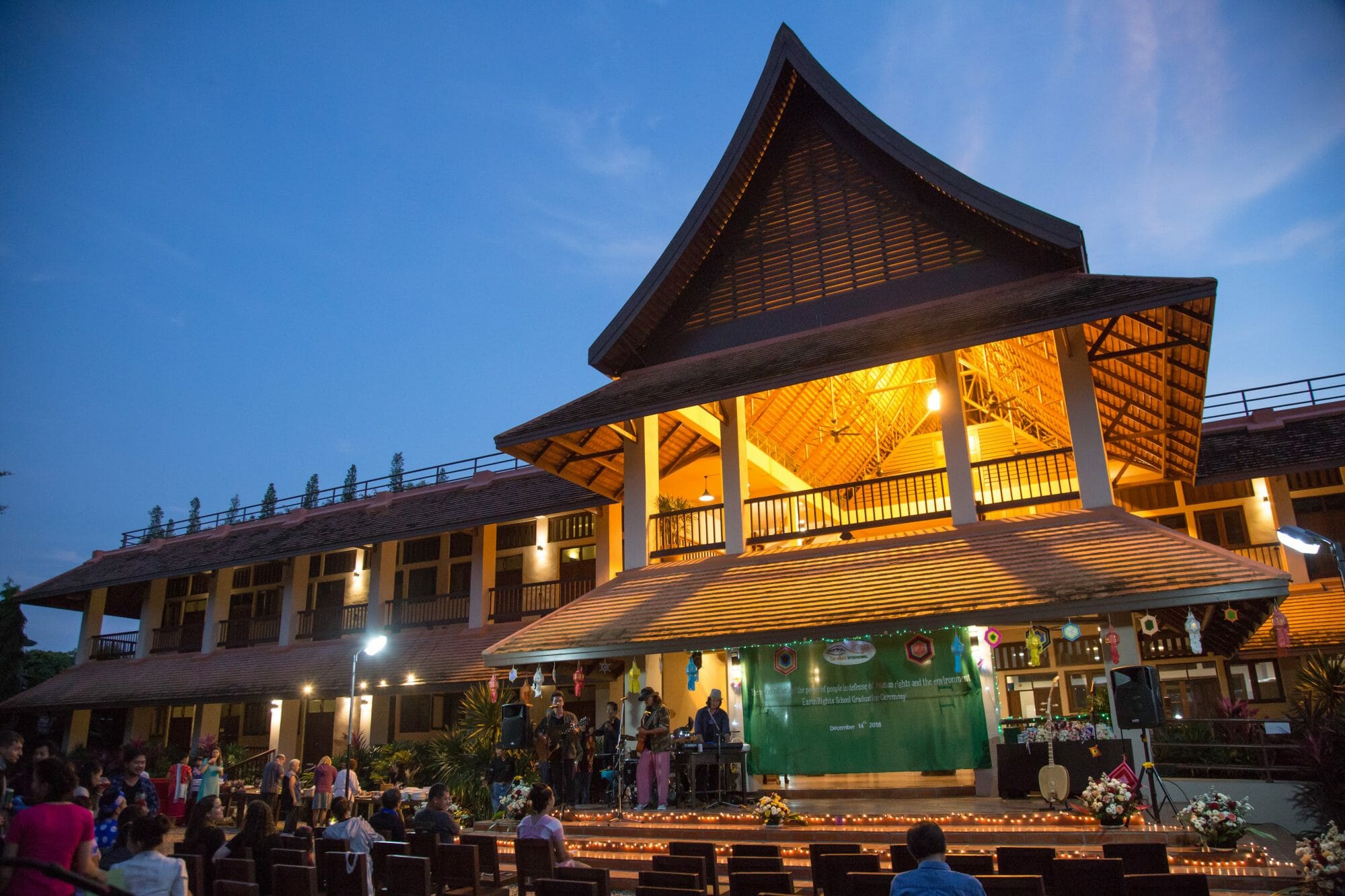
The EarthRights School (ERS) Mekong is a 7-month residential training program in the Mekong Region for community-based advocates from Cambodia, Laos, Myanmar, Thailand, and Vietnam who are working on environmental and human rights issues.
The goal of ERS is to train grassroots and community leaders about the impacts of large-scale development projects on communities and the environment, and how they can advocate for more equitable development in their communities.
ERS Course Curriculum
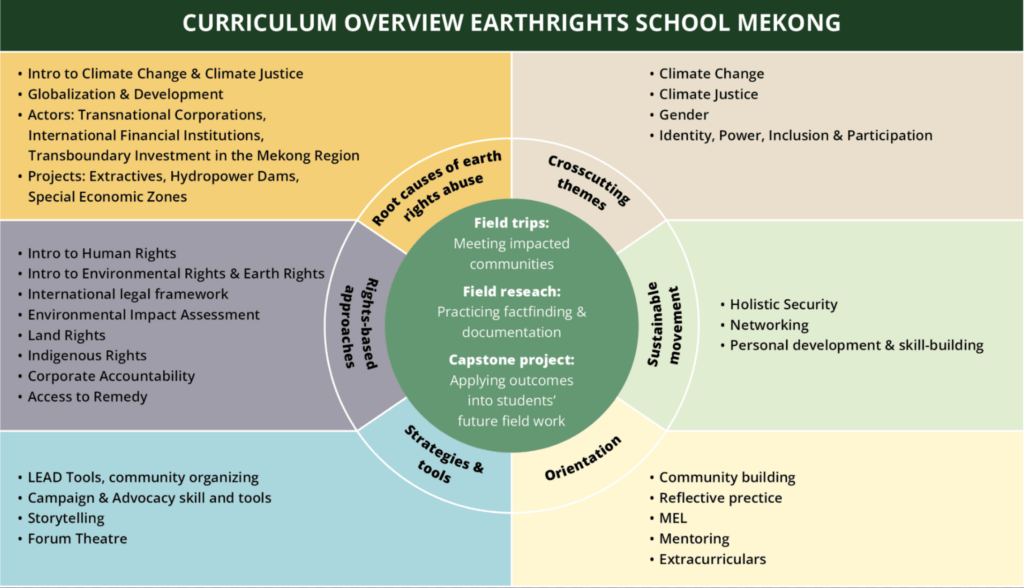
Root cases of earth rights abuse
- Intro to Climate Change & Climate Justice
- Globalization & Development
- Actors: Transnational Corporations, International Financial Institutions, Transboundary Investment in Mekong region
- Projects: Extractives, Hydropower Dams, Special Economic Zones
Crosscutting Themes
- Climate Change
- Climate Justice
- Gender
- Identity, Power, Inclusion & Participation
Sustainable movement
- Holistic Security
- Networking
- Personal development & skill-building
Orientation
- Community-building
- Reflective practice
- MEL
- Mentoring
- Extracurriculars
Strategies & tools
- LEAD tools, community organizing
- Campaign & Advocacy skill and tools
- Storytelling
- Forum Theatre
Rights-based approaches
- Intro to Human Rights
- Intro to Environmental Rights & Earth Rights
- International legal framework
- Environmental Impact Assessment
- Land Rights
- Indigenous Rights
- Corporate Accountability
- Access to Remedy
Target group and eligibility
Who can apply?
- Individuals working for an organization associated with EarthRights alumni and community partners or individuals with proven community work experience in environmental and human rights advocacy.
- Community leaders, organizers, trainers, advocates, campaigners, researchers, and junior lawyers with a minimum of 2-3 years of proven field experience who wish to develop their skills further.
- Individuals working with a community affected by harmful development projects or those employed by an organization that collaborates with such local communities on human rights and environmental rights issues.
Requirements
- Applicants must demonstrate a commitment to returning to their organization or community or to a similar initiative with the intention of supporting local communities after completing the program.
- Participants’ organizations must agree to support participation before, during, and after ERS and help to integrate the lessons learned into the organization’s future activities.
- Participants will be away from work for 7 1⁄2 months full time and must participate in in-person classes and assigned fieldwork. They must prioritize their studies with us over other work, studies and schedules.
- Ability to communicate the fundamentals of human rights and environmental justice in English, as well as topics related to a participant’s work, and willingness to make an effort to improve their English language skills as needed.
- The desire to work with other activists and respect diversity and other people’s knowledge, background, and experience.
**ERS encourages applications from women, members of Indigenous groups, and those living and working in rural communities. We uphold a policy of non-discrimination based on race, nationality, ethnicity, religion, political belief, age, gender, physical ability, or sexual orientation.**
Knowledge and skills development
By participating in this program, you will gain:
- An understanding of environmental and human rights issues: You will develop a deep understanding of the environmental and human rights challenges faced in the Mekong Region and globally.
- Advocacy skills: You will be equipped with skills to raise awareness for protecting human rights and the environment.
- Community organizing and resource mobilization skills: You will learn to co-develop with communities to identify environmental issues, organize collective actions, and carry out resource mapping and mobilization.
- Stakeholder analysis: You will gain the ability to identify and analyze the roles of various stakeholders involved in earth rights abuses, as well as the financial systems and power structures that support them.
- Strategic planning: You will create a clear and actionable plan to address the challenges your community faces, adapting and enhancing existing initiatives.
- Research skills: You will enhance your ability to conduct evidence-based research and explore local, regional, and global contexts related to environmental and human rights issues, enabling you to identify root causes and stakeholders involved in these challenges.
- Legal knowledge: You will acquire a basic understanding of your legal rights and know how to use them to protect yourself and your community from any human rights threats.
- An understanding of diversity, equity, and inclusion principles: You will learn to respect the differences and appreciate the similarities of others in terms of values, culture, backgrounds, and experiences.
- Improved security practices: You will learn to integrate risk assessment and management strategies and prioritize the security of yourself and the communities you work with.
- An understanding of self-care and community well-being: You will gain insight into the connection between mental, emotional, social, legal, and physical health, essential for your well-being and others.
- Opportunities for networking and collaboration on the regional level: You will create a strong connection with other earth rights defenders in ERS and in the larger network.
Program elements
The training program is 71⁄2 months long, full-time, in-person, residential in Chiang Mai.
You will live and learn together with a cohort of 14-16 other activists from across the Mekong Region. This immersive experience allows for continuous learning, both inside and outside the classroom, fostering a collaborative environment.
Throughout this period, you will attend daily lessons that deepen your understanding of the program’s themes and essential skills, such as stakeholder mapping, research writing, digital literacy, security practices, facilitation, storytelling, teamwork, communication, media messaging, and strategic campaigning.
The field trips and 1-month field research will enable you to apply what you have learned in real-world contexts by interacting with partner communities in Thailand and your own country.
As you acquire new skills and knowledge, you will have the chance to develop and refine an action plan for the future. By the end of the program, you will have a plan for a project, campaign, or other form of intervention ready for implementation with your organization or community. EarthRights may provide follow-up support for project execution, including additional training, coaching and consultations, and for your continued engagement within the network.
The program’s schedule is rigorous, with classes running Monday through Friday full time each day. Specific times may vary based on the trainer and content. You will also work on individual and group assignments, which are completed during evenings or weekends.
Additionally, you will have opportunities for consultations with your trainers and mentors, allowing you to seek feedback and advice related to the specific context and challenges of your work.
Upon graduation, you will join our extensive alumni network and gain access to our Alumni Engagement Program.
**ERS is an independent program and is not affiliated with any university. Thus, it does not offer any academic credit.**
Learning approaches and methods
ERS emphasizes the value of local knowledge, wisdom, and life experiences of participants. Therefore, it adopts a participatory learning approach. Participatory learning and teaching methods focus on maximizing the engagement of students in the learning process. It includes sharing and learning from your strengths and life experience as well as those from others and using activities that allow learning by doing. All classes incorporate hands-on learning, which includes:
- Active learning: Problem-solving, discussion, critical thinking, asking questions, debate, brainstorming, making connections to your life experiences and your classmates’, working with examples from field case studies, field trips, and the practicum.
- Cooperative learning: Teamwork, working together on projects and problems, learning from and supporting each other, practicing commitment in action, empathy, clear and sensitive communication, and effective time management.
- Experiential learning: Learning lessons through experiences such as role-play, theater, presentation, digital content creation, simulation, outdoor activity, body movement, and working on the field with community organizations. After going through an experience, we always reflect, draw our conclusions, and identify our learning outcomes and how we can build on them in the future.
- Homework, individual and group assignments, and consultations: Applying and adapting the program’s content and skills to your specific local context and practice. They are an integral part of the learning process and help you to move from knowing to knowing how and to doing.
Commitments and requirements of participation
- You commit full-time participation during the program, including 7 1⁄2 months in-person in Chiang Mai and a 4 to 6-week field practicum, which requires local implementation and regular check-ins online, survey assessments, and focused group discussion after graduation to determine impact. It is not allowed to arrive later or leave earlier than the program dates or to miss any parts of the program.
- You come prepared for the in-person training with a project/campaign/advocacy idea that addresses human rights and environmental issues that your community is facing and your organization is working on, to use and present it as an example and case study.
- You have strong elementary or intermediate English language skills (speaking, listening, reading, and writing) with a commitment to learning and practicing English. You should be able to communicate your ideas and discuss topics related to human and environmental rights. You must be willing to improve your English skills during the whole program. If you are shortlisted, your English skills will be assessed.
- You live at the training venue and follow the ground rules of the training as well as the rules of the venue regarding code of conduct, security, safety, and communal living.
- You will participate in and be responsible for housekeeping duties, such as cooking, cleaning, and maintenance work.
- You must be open to meeting and creating a community with people from different backgrounds and must respect people’s backgrounds and identities. You must participate in communal life and participatory decision-making with diverse people.
- You follow and respect ERS’s non-discrimination policy. ERS has zero tolerance for discriminatory attitudes and behaviors based on race, nationality, ethnicity, religion, political beliefs, age, gender, physical ability, sexual orientation, or other status.
- You attend all classes. In class, you are expected to participate in the experiential and participatory learning activities and methods as mentioned in the Learning Approaches and Methods section. You must be on time for the in-person sessions, meetings, and activities. You must complete and submit your individual and group assignments on time by their deadlines.
- You prioritize full participation during the program over other work and studies. We will not accept students who are currently studying in a university or other educational programs. You will need to communicate and agree with your organization to take 7 1⁄2 months leave from work to participate in the program.
- You have a passport valid until the July of the year after your course. EarthRights will not pay for your passport.
Application and selection process
- The application deadline is announced in the Call for applications of the actual year. We may re-launch the call for applications in certain countries, depending on the availability of slots. Applications received after this deadline will only be considered under exceptional circumstances.
- Applications must be submitted via the online form here. Complete the application form by yourself and answer the questions in English language only. It is alright to use simple words; you do not have to write at an academic level.
Tip: Make it personal, simple, and based on your experience. Do not use AI, and do not copy content from your organization or your previous applications for work or other programs.
- References: You must have 2 people complete the recommendation form. Your references must come from a teacher from your previous studies, an EarthRights alumni, or a community / organization leader. These recommendation forms must be submitted together with your application.
- Due to the high number of applicants, ERS will only contact shortlisted individuals for the interview to assess their English language and critical thinking skills.
- Those who are not selected will be on the waiting list. In case a shortlisted individual drops out, people on the waiting list will be contacted and offered the opportunity to join.
We invite you to attend the online information meetings held every year and contact us if you have any questions about this year’s program.
Testimonies
I learned more than I expected. I studied new subjects that I had never learned before. I learned about world issues and harmful development projects in different kinds of countries. These lessons changed my way of thinking. I learned that I must know my rights to fight harmful projects. I believe the things I learned can be useful for my work, my region, and my country.
– Eh Doh Ah, Myanmar
At the beginning, it was very difficult for me. I felt scared and not confident at all. But with the support from my classmates and the teaching team, I slowly became more confident in communicating and improved little by little. Now, I can talk and share ideas with friends from other countries with confidence.
– Jane, Thailand