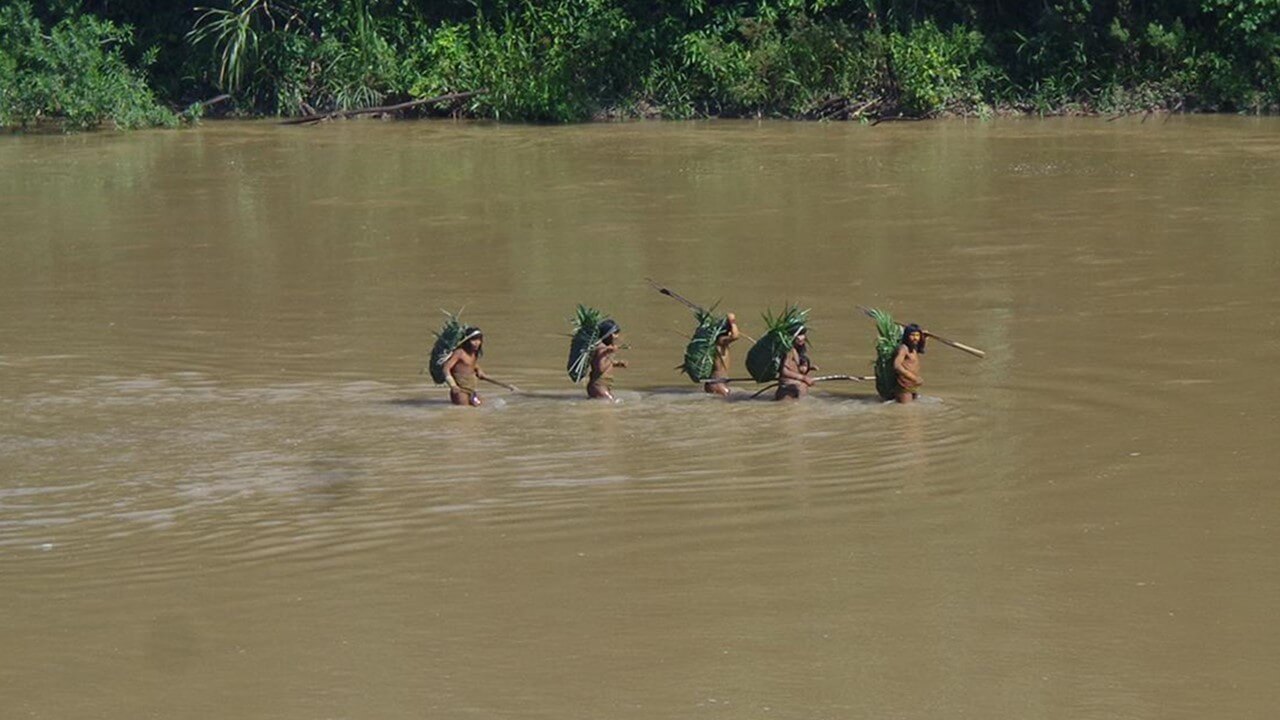
- For the first time, the Inter-American Court of Human Rights (IACtHR) will review a case against the Peruvian government for endangering the lives and physical integrity of an Indigenous people living in voluntary isolation. The public hearing will take place on September 24 and 25, 2026, in Montevideo, Uruguay.
Madre de Dios/Lima, August 27, 2026 – The Native Federation of the Madre de Dios River and Tributaries (FENAMAD) and EarthRights International filed a complaint that seeks to protect the survival of the Mashco Piro Indigenous people living in voluntary isolation in the Peruvian Amazon. The expansion of extractive activities authorized by the Peruvian government severely affected the Mashco Piro’s territory and livelihood. The public hearing before the Inter-American Court of Human Rights will take place on September 24 and 25, 2026, in Montevideo, Uruguay.
The environmental destruction of the ancestral territory inhabited by the Mashco Piro—which extends from the southeastern Peruvian Amazon to the state of Acre in Brazil—threatens their livelihood. The logging concessions granted by the government expose them to forced contact with outsiders, significantly increasing the risk of disease transmission that could lead to their physical extermination.
The Inter-American Commission on Human Rights (IACHR) has stated that resource extraction and the incursion of third parties violate the principle of non-contact and the right to self-determination—specifically, the right to remain in isolation from the outside world—thereby placing their physical, spiritual, and cultural integrity at serious risk. Therefore, the state’s promotion of extractive projects contradicts its duty to guarantee the real and effective protection of these peoples’ fundamental rights.
A Historic Event and a Precedent for Indigenous Peoples in the Region
This case represents a historic milestone in Latin America; the Court’s decision will not only have an impact on Peru but will also set a legal and political precedent for all Indigenous peoples of the Amazon.
A favorable ruling will contribute to:
- Reaffirming the obligation of States to implement the necessary measures to ensure respect for the principle of non-contact and the self-determination of peoples in isolation.
- Strengthening the international legal framework regarding Indigenous and environmental rights.
- Paving the way for other peoples in similar situations who face threats from extractive activities, deforestation, and infrastructure projects.
The Mashco Piro People’s Struggle for Survival
Since the 1990s, FENAMAD—an Indigenous organization representing the peoples of the Madre de Dios region—has denounced the threats that extractive activities pose to the lives and health of the Mashco Piro, considered one of the world’s largest peoples living in voluntary isolation. In 2005, given the severity of logging activities in the territory, the organization requested urgent protective measures from the Inter-American Commission on Human Rights (IACHR), which were granted in 2007.
In 2011, the organization filed a petition with the IACHR, which concluded in its 2022 Merits Report that the Peruvian government was internationally responsible for violating the rights of the Mashco Piro people as recognized in the American Convention. Given the government’s failure to comply with the Commission’s recommendations, the case was referred to the Inter-American Court of Human Rights (IACtHR) in 2024.
Key Aspects of the Complaint
The organizations representing the victims are asking the Inter-American Court of Human Rights to recognize the violation of the rights of the Mashco Piro people and to order the Peruvian government to guarantee the comprehensive protection of the interethnic territory they inhabit.
The claims include the protection of the following rights:
- Life, personal integrity, and health
- A healthy environment
- Collective property
- Cultural identity
- Self-determination
For more details, visit: The Case of the Mashco Piro Indigenous People Before the Inter-American Court of Human Rights
Media Contacts:
María Paula Riveros Forero, EarthRights International Latin America Office
maria.paula@earthrights.org
Cell (+57) 3118548763
Daniel Khennyi Peña Pérez, FENAMAD
khennda@gmail.com
Cell (+57) 3118548763
About FENAMAD
The Native Federation of the Madre de Dios River and Tributaries (FENAMAD) is an Indigenous organization in the Peruvian Amazon that represents the region’s peoples and has been defending their territorial and cultural rights for more than four decades.
About EarthRights International (ERI)
EarthRights is an international nonprofit organization that, since 1995, has combined the power of the law with the power of the people to defend human rights and the environment. In Latin America, ERI works alongside ethnic communities to confront abuses committed by corporations and governments, pursuing strategic litigation to strengthen community resilience.