A Community in Cambodia continues to stand its ground amidst growing threats to their land and environment from liquified natural gas (LNG) and Special Economic Zone (SEZ) projects. Over the past 3 years, residents have set up an independent monitoring system, mapped their resources, pushed for the disclosure of Environmental Impact Assessments (EIA) of development projects, and developed coordinated advocacy plans. About 60 households refused unfair compensation in exchange for their land. Their self-advocacy has contributed to increased responsiveness of local authorities, stoppage of forced evictions in some locations, and recent reduction of harassment incidence, among others.
EarthRights played a key role by partnering with the community and other organizations to deliver an integrated approach, combining community organizing, rights-based training, Community Natural Resource Mapping (CNRM), advocacy support, and livelihood initiatives – strengthening both local capacity and long-term resilience.
Advocacy in the community has increasingly been inclusive and collaborative. Women who were once hesitant now actively participate, lead, and often outnumber men in community activities. Meanwhile, men have grown more supportive, even sharing household responsibilities to enable women’s participation.
| “A major change has occurred for women, who are now actively involved in filing complaints and petitions to government authorities, with men supporting them from behind.” –Community Member “This does not mean that men are not making changes; rather, they have shifted their attitudes to allow their wives to participate in community work, including training outside the community. When women are away from home, their husbands take on the responsibility of caring for the children and the housework.” –Koh Kong Coalition Partner Representative |
Furthermore, the community demonstrates strong solidarity and collective action internally and across a network of villages. Leaders and members collaborate on key advocacy efforts, including requesting EIA disclosure, developing action plans, completing the CNRM process, and establishing a monitoring system to track development impacts and corporate activities. They also funded a community center for meetings and discussions. Regular meetings address local issues and plans, while traditional events such as harvest ceremonies and Human Rights day have resumed, strengthening both cultural values and advocacy. Participation in these events have increased among both Christian and Buddhist members.
| “…support for advocacy work in the target community is growing, with an increasing number of community groups forming. This has helped reduce fear of threats, empowering individuals to stand up and voice their concerns to local authorities.” -Community Member |
The supported community is empowered to map and plan for land and resource use. The Community uses CNRM to plan and manage their land and resources. Through regular discussions, members use it to guide protection efforts. The mapping has helped them to understand their resources, identify threats, and clarify land use and boundaries. It has been especially valuable for spotting development encroachment, disputed areas, and key farming and fishing areas. The map also supports community-led campaigns to restore resources and protect resources, with plans to strengthen advocacy as monitoring continues.
| “We gained a comprehensive understanding of the village’s land, including its infrastructure, boundaries, and geographic areas, which encompass both residential and agricultural land.” “The mapping process also highlighted the locations of mangrove forests and their critical importance for biodiversity and climate change. When we mapped and had a detailed discussion with our elders, we realized that mangrove forests are being encroached upon and cleared by individuals for ownership.” “We identified areas of conflict that overlap with development projects on community agricultural land, enabling us to prepare for potential land disputes and reclaim the lost area.” Members of the Community |
Why it Matters
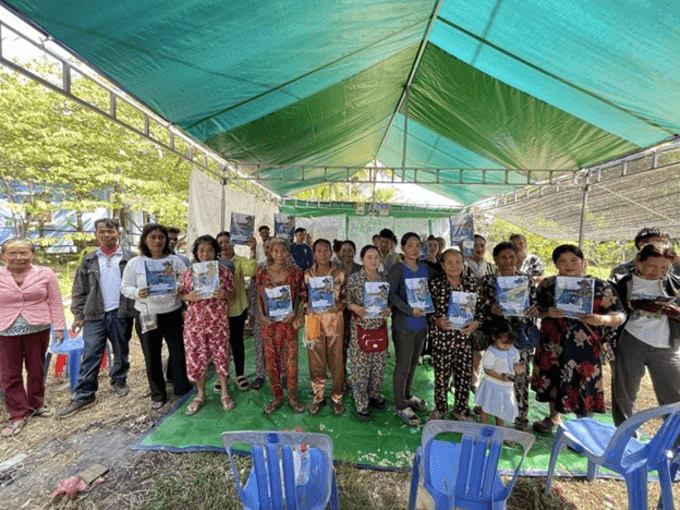
Community Members Showing the CNRM they Produced
Self advocacy among Cambodian Communities become more important as large-scale development projects profess to provide economic gains for the broader Cambodian population at the detriment of these Communities. SEZ are expanding in Cambodia and other large-scale multi-million development projects are particularly affecting many communities. Large-scale acquisitions of land for development projects have resulted in displacements of local communities, often with insufficient compensation. Deforestation, air pollution and water contamination are a few of the issues observed in more than thirty-one SEZ in Cambodia. Local livelihoods such as fisheries and dry agriculture have been largely detrimentally affected. The Cambodian government has approved a multi-billion investment for an LNG powerplant which will build an LNG receiving port and storage tanks in areas crucial for local livelihood. Displacement and loss of access to coastal resources are just a few of the issues foreseen by the residents.
Our Contribution and Support for the Cambodian Community
| 63 Community monitors, facilitators, and defenders were trained | About 355 Community members participated in CNRM and advocacy meetings | From 2022-2025, Community members were mentored to build skills for monitoring, mapping and advocacy |
From 2022 to 2025, EarthRights supported the affected communities through training, advocacy, community organizing, and natural resource mapping.EarthRights provided Local Engagement and Accountability Dialogue (LEAD) training for community members, covering essential topics such as social, environmental, and health impacts, data collection tools, and assessment methodologies. This training included CNRM, Community Grievance Mechanisms (CGM), Health Impact Assessment (CHIA), and Environmental Impact Assessment (EIA). Additionally, a collaborative action plan was established with local NGOs during a three-day workshop. In 2023,EarthRights supported community leaders in conducting CNRM to evaluate the impacts of this change. 16 local data collectors were trained to analyze resource use, livelihoods, and environmental effects in their communities. In 2024 and 2025, more than 300 members of the community participated in CNRM and advocacy initiatives, 25 were trained as facilitators and 13 were trained on the EIA process.