- Each year, hundreds of people face violence and harassment for speaking up in defense of the environment. Protecting environmental defenders requires an “all-hands-on-deck” approach, with multilateral and regional organizations like the United Nations (UN) and the Inter-American human rights system playing an essential role.
- However, environmental defenders sometimes hope for more from multilateral and regional organizations than they currently receive. In this article, we examine the five types of support that multilateral and regional organizations should strive to provide for defenders, even in an underfunded and fractured political environment.
- Rather than treat multilateral and regional organizations as a one-stop shop for protecting environmental defenders, we also recommend specific ways to ensure that these mechanisms serve effectively as part of a holistic protection strategy.
Each year, hundreds of people around the world face threats for speaking up in defense of the environment and criticizing natural resource exploitation projects that harm their communities. Global Witness reports that in 2025, 146 environmental and land defenders were reported murdered or disappeared for their work, while over 2,000 defenders have been reported as killed or disappeared since 2012. Direct violence is one piece of the story, but not the full one: the Business and Human Rights Centre identified 426 publicly reported attacks against environmental and Indigenous rights defenders in 2025, which primarily consisted of misuse of the law and courts, in addition to killings, physical violence, and other types of attacks. Reported numbers of attacks are likely significant underestimates of the true number of environmental defenders attacked each year.
Attacks often originate from powerful actors, such as political, economic, and military elites who have a stake in a natural resource project that has generated opposition from local communities. The attacks tend to escalate over the years, beginning with smear campaigns and threats and leading to violence. Criminalization—when powerful actors attempt to silence their critics or political opponents by infringing on their legal rights or smearing them as criminals, terrorists, foreign agents, or other enemies of the state—is a throughline across many attacks against environmental defenders.
Because the nature of these attacks is often complex, environmental defenders depend on several types of support to remain safe.
The Support that Environmental Defenders Need
Stakeholders across sectors have an important role to play in protecting and supporting environmental defenders. Indeed, experience suggests that the most effective responses to this violence involve coordinated efforts by multilateral and regional organizations, national governments, civil society, philanthropy, and businesses. Generally speaking, these stakeholders can use the following five intervention pathways to effectively support environmental defenders. An ideal defenders protection strategy includes all five pathways, as each serves a distinct role:
- Preparation: Provide defenders with the tools, resources, and support networks they need to mitigate risks before attacks.
- Preemption: Identify and counter rising threats before they escalate through early stage interventions.
- Emergency Response: Provide emergency response resources in cases that have already escalated to violence.
- Accountability: Raise the political, legal, economic, and reputational costs that perpetrators face, in order to provide remedies for victims and deter future attacks.
- Civic Space: Strengthen civic space so that environmental advocates can speak up safely and without fear in their home countries.
In recent years, there has been a particular interest among many stakeholders in mobilizing and strengthening multilateral and regional organizations’ ability to help reduce violence against environmental defenders, as well as other kinds of human rights defenders. In this article, we assess how today’s multilateral and regional organizations measure up in providing these protections for environmental defenders and where opportunities for reform might exist.
While host countries and businesses hold the primary responsibility for protecting environmental defenders, and civil society and philanthropy have played a critical role in serving as first responders for defenders at risk, multilateral and regional organizations can play an integral role in serving environmental defenders who do not find protection at home.
The Support that Environmental Defenders Get
Several UN resolutions, as well as regional treaties such as the Aarhus Convention in Europe and the Escazú Agreement in Latin America, call for governments to take steps to reduce violence against environmental defenders and other kinds of human rights defenders. These commitments do not carry any real protection value, however, until they are implemented in practice. At the multilateral and regional levels, this often translates into several types of mechanisms:
- Rapid response mechanisms — financial, relocation, or other resources for environmental defenders facing immediate threat;
- Special rapporteurs — independent experts appointed to report on a human rights issue, who can apply diplomatic pressure in certain cases;
- Investigative and judicial mechanisms — multilateral and regional fact-finding and accountability procedures, some of which have the enforceable power of courts themselves, and some of which strengthen the effectiveness of national-level courts;
- Complaint mechanisms — grievance and oversight processes within multilateral and regional bodies, which typically have soft power to conduct compliance reviews, mediate disputes, and recommend solutions;
- Country review mechanisms — periodic treaty-mandated policy and implementation reviews of member states, which examine broader trends across a country and which can help draw attention to restrictions on civic space.
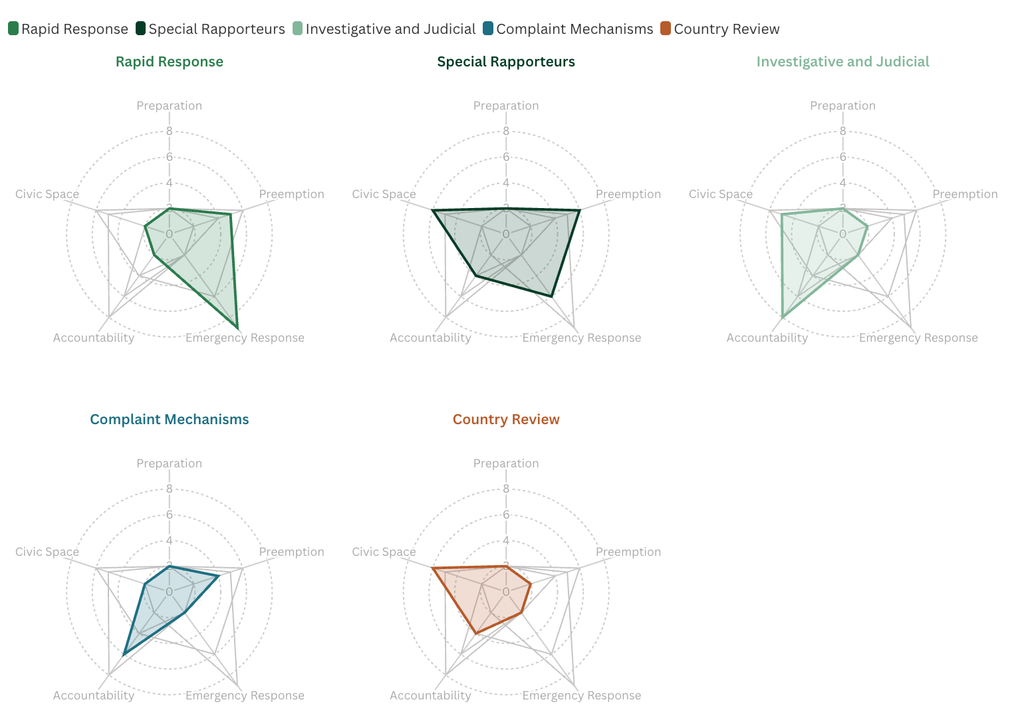
We examined these categories of mechanisms and evaluated their potential practical utility in supporting at-risk environmental defenders based on the extent to which they can contribute to the five intervention pathways described above: preparation, preemption, emergency response, accountability, and civic space. This is how they stack up:
Multilateral Rapid Response Mechanisms
On-call resources for environmental defenders in crises are important lifelines, but the majority of rapid response resources for environmental defenders are directed by civil society and the philanthropic sector, not by multilateral institutions. Rapid response mechanisms available through multilateral or regional institutions include the EU’s Human Rights Defenders Mechanism (Protectdefenders.eu) and a point of contact at the United Nations Environment Program.
Meanwhile, some independent rapid response mechanisms are funded by a coalition of governments and foundations without the explicit involvement of multilateral and regional organizations. Notably, after political changes in the United States led to the shutdown of the Lifeline program that supported at-risk human rights defenders, governments and private philanthropy teamed up to launch the Lighthouse Global Protection Fund in early 2026.
Special Rapporteurs and Country Offices
The special rapporteur system, in which multilateral and regional bodies designate independent experts to monitor and report on a particular human rights issue, has helped give environmental defenders a voice in international governance. While many special rapporteurs touch on defender issues from time to time, roles with explicit mandates for reporting on human rights defenders are the United Nations Special Rapporteur on the situation of human rights defenders; the Special Rapporteur on Environmental Defenders under the Aarhus Convention, which covers much of Europe and Central Asia; and the Inter-American Commission on Human Rights Rapporteurship on Human Rights Defenders and Justice Operators. These special rapporteurs can conduct fact finding, raise the public profile of cases, consult with civil society, advocate within the multilateral or regional system for interventions, and engage with governments to encourage interventions or advocate for or against policy impacting defenders. However, these roles are underfunded, country visits require state agreement, and the influence of the role depends heavily on the priorities and diplomatic skill of each special rapporteur.
The UN and the Aarhus Convention also have in-country offices that environmental defenders may be able to make use of. The OSCE reports that it maintains over 60 Aarhus Centres across 14 countries, which seek to engage the public, the private sector, and the government on environmental issues. The UN Human Rights country offices conduct monitoring and provide technical assistance to governments, civil society, and human rights defenders. Representatives of these offices often play an important role in intervening diplomatically on behalf of at-risk defenders.
Investigative and Judicial Mechanisms
Multilateral and regional investigative and judicial mechanisms can be a strong tool through which environmental defenders can pursue accountability, but they often have high barriers to entry and can be weak in practice. Particularly strong examples of functioning regional judicial mechanisms include the Inter-American Court of Human Rights (IACHR) (and the corresponding Inter-American Commission on Human Rights) and the European Court of Human Rights (ECHR). However, these and other investigative and judicial mechanisms are often only available to victims of human rights abuses after they have exhausted all avenues of domestic remedy, placing a prohibitive time, cost, and risk barrier in front of environmental defenders seeking accountability for time-sensitive threats. In practice, the courts have only considered a tiny sample of the thousands of cases of attacks on human rights defenders.
Outside of the IACHR and the ECHR, other bodies exist that ostensibly seek to provide justice for human rights abuses, or which could be levied to provide justice for them. These include the African Commission on Human and Peoples’ Rights, African Court on Human and Peoples’ Rights, Permanent Court of Arbitration (PCA), the Court of Justice of the EU (CJEU), African Court on Human and Peoples’ Rights, and sanctions powers held by the UN Security Council and European Union. However, to date these organizations do not appear to have provided recourse to environmental defenders.
Complaint Mechanisms
Complaint mechanisms such as OECD National Contact Points for Responsible Business Conduct and internal complaint mechanisms in international financial institutions (like the World Bank Group) and development organizations (like the UN Development Program) exist to hold institutions accountable to the communities they impact. While in theory they can be used by environmental defenders, there are few examples of these mechanisms being used to resolve these kinds of cases. Additionally, these mechanisms are often systematically weakened through competing interests within the institutions in which they sit, involve lengthy processes, and at present are unlikely to provide meaningful remedy for those who have suffered human rights abuses.
Country Review Mechanisms
Many international treaty bodies conduct country review mechanisms, in which a country’s policies and practices relevant to a given treaty are evaluated on a regular basis, and to which countries may be required to respond and implement changes. While these review mechanisms do not provide direct support to environmental defenders, they can be mechanisms through which environmental defenders and their supporters draw attention to systemic threats and pressure countries to improve their policies and practices.
Relevant review mechanisms for environmental defenders include those run by the UN Human Rights Council’s Universal Periodic Review, the Organization for American States, the EU’s Commission on Human Rights, the UN Office on Drugs and Crime, the Group of States Against Corruption, the Financial Action Task Force (FATF), the UN Convention Against Corruption, the OECD Working Group on Bribery, the UN Convention Against Transnational Organized Crime, OECD’s Public Integrity Indicators, and the UN Human Rights Committee.
The utility of these reviews varies by treaty mechanism, and many do not currently consider human rights, let alone the human rights of those who speak up about environmental issues. However, in addition to the impact of the review mechanism itself, civil society often uses review mechanisms—such as Universal Periodic Reviews—as opportunities to craft and publicize “shadow reports,” in order to raise concerns that governments themselves might not raise.
The Support that We Can Build for Environmental Defenders
The multilateral mechanisms that exist provide necessary support to environmental defenders, but they are generally narrowly focused, not empowered to integrate with their organizations’ other programs and efforts that carry more diplomatic or financial weight, and unable to operate at the scale needed to respond to the volume of attacks occurring each year. This leaves major gaps in support, particularly when it comes to preparation for at-risk defenders, preemption of threats in the early stages before they escalate, and protecting civic space.
As a result, multilateral and regional bodies are unlikely to become a “one stop shop” for fulfilling all the needs of environmental defenders at risk. However, through targeted interventions, these institutions can continue to grow more effective in contributing to the broader ecosystem of support that defenders require.
For example, here are corresponding steps that multilateral institutions and their supporters can take to create a safer, stronger world for environmental defenders by strengthening the five intervention pathways described above. Some of these strengthen the work done by the multilateral institutions already operating with an environmental defenders mandate, while others invite new players to the table.
PREPARATION: Connect defenders across local, regional, and international levels.
Implementers: Special Rapporteurs, country offices, and the broader multilateral system.
Even in the current political context, civil society networks of support for human rights defenders have continued to operate effectively. Organizations like the Alliance for Land, Indigenous and Environmental Defenders (ALLIED) help to connect local “first responder” emergency networks for defenders with national, regional, and international allies. Individual representatives of multilateral and regional bodies, as well as those of governments and businesses, can play an important role in coordinating with these networks to support those who are at risk.
PREEMPTION: Develop embassy leadership.
Implementers: Country offices and the broader multilateral system.
We also need to remain realistic about the potential and limitations of multilateral and regional bodies to contribute to the protection of defenders – it is important to invest in other government-based interventions, as well. Embassies are an underused resource when host country, regional, and multilateral bodies fall short. Embassy officials often have direct access to political, economic, and military elites in a host country who might be involved in threats against human rights defenders or who might have leverage over the perpetrators. Governments promoting human rights and environmental protection should continue to scale up the ability of their embassies to promote freedom of speech and assembly, intervene in cases in which defenders are being targeted, and call for accountability when defenders are harmed. The EU and some EU member states continue to be leaders in this space. Meanwhile, embassies from the United States have played an important leadership role in the past and will hopefully reemerge in the future.
EMERGENCY RESPONSE: Contribute to rapid response mechanisms, either financially or in-kind.
Implementers: Rapid response mechanisms, special rapporteurs, country offices, and the broader multilateral system.
Governments and private philanthropy can and should put more resources into rapid response mechanisms supporting environmental defenders. It is understandably difficult for multilateral and regional bodies, which are themselves cash-strapped, to contribute to these funds. However, representatives of these bodies can contribute in-kind by helping to educate the public and the donor class about the existence of and need for these mechanisms.
ACCOUNTABILITY: Support efforts to increase pressure on the perpetrators.
Implementers: Investigative and judicial mechanisms and complaint mechanisms.
Ultimately, perpetrators will continue to criminalize and attack environmental defenders as long as it is cheap and easy to do so, and as long as they face almost no risks of consequences. Multilateral and regional organizations, governments, and the private sector alike often fall short on demanding accountability for those responsible for attacks. However, numerous options exist to raise the political, economic, legal, and reputational costs on those who try to silence human rights defenders through violence.
The United Nations and other multilateral and regional organizations are well-placed to emerge as leaders on this issue — for example, by recognizing criminalization as a form of human rights abuse and communicating an expectation that governments provide a remedy when it occurs; and by breaking down siloes within their own bureaucracies to ensure that their financial, counter-terrorism, and development arms all play a role in stopping these attacks.
CIVIC SPACE: Integrate environmental defenders policy across the UN.
Implementers: Country review mechanisms and the broader multilateral system.
The United Nations Environment Program has an existing Environmental Defenders Policy, but the policy is not integrated across the broader UN system. UN institutions focused on climate change, food and agriculture, biodiversity, digital protection, and cultural heritage all implicitly concern environmental defenders, and formalizing their understanding and treatment of environmental defenders could give environmental defenders a much bigger voice across issue areas. However, the time horizon for these kinds of civic space interventions needs to be intentional. For example, many recent civil society and philanthropic efforts have focused on strengthening the recognition of environmental defenders as key stakeholders in the UN climate change negotiations. While important in the long-term, these interventions might have less practical impact in the short- and medium-term than efforts to build civic space in other multilateral and regional forums where governments already have a strong track record of real-world implementation.
The multilateral system is vast, and change moves at a slow pace. However, these recommendations can all be implemented on short- and medium-term horizons while having meaningful impact on the lives of environmental defenders, and thus, on society as a whole.
Respect for human rights and environmental protection do not happen by themselves. They arise when courageous people speak up and demand respect for their rights and then continue to defend their rights after they’re obtained. It’s time to give environmental defenders the protection they need as they fight for a better world for all of us.