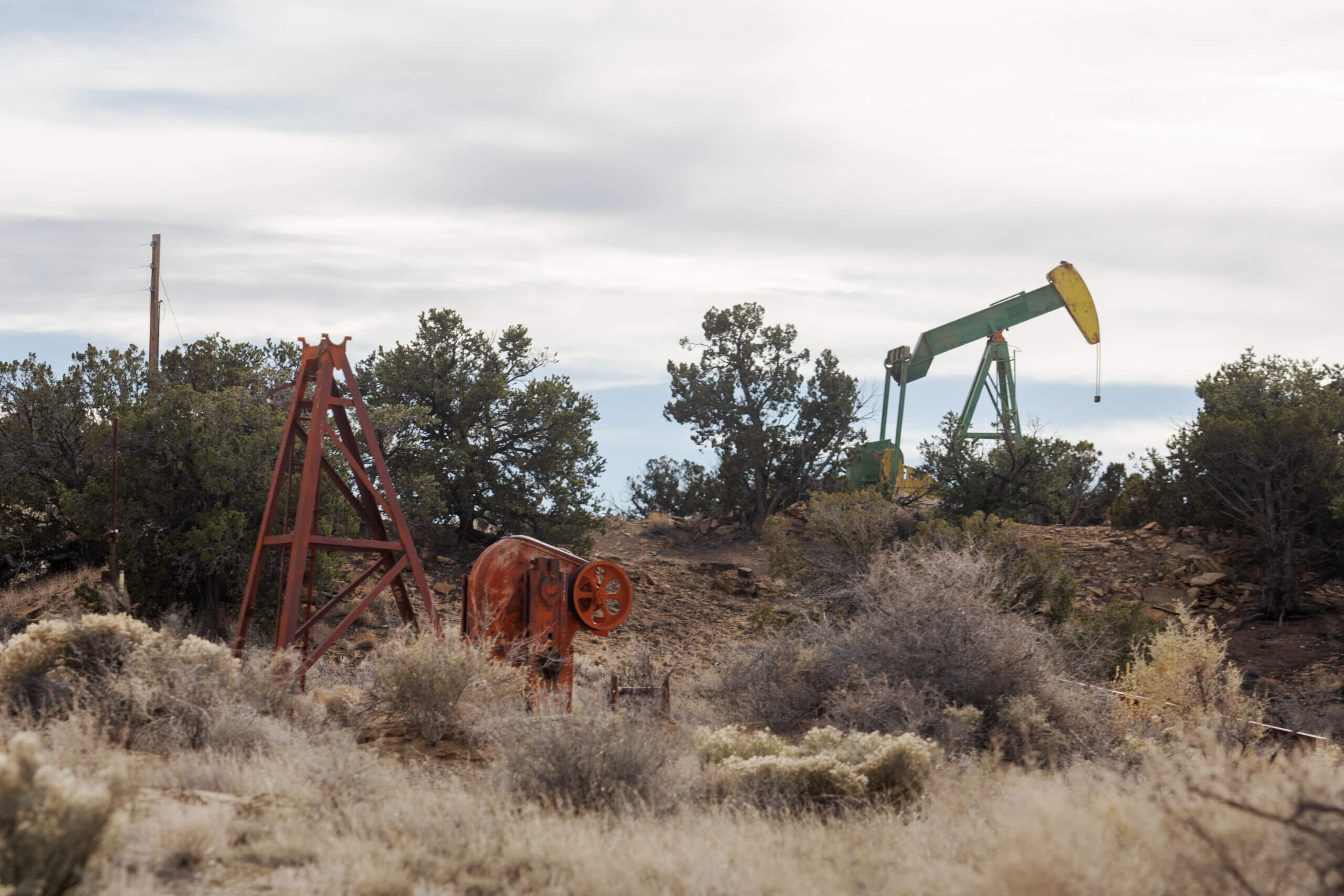
- America’s over one million orphaned and abandoned oil and gas wells are associated with environmental and health harms and are expensive to clean up
- Oil and gas-producing states have laws requiring companies to take responsibility for plugging depleted oil and gas wells, but these laws are not often enforced—and are being actively evaded by some companies
- It’s time to ensure that oil and gas well operators clean up after themselves and stop offloading the costs onto the public
Over one million orphaned and abandoned oil and gas wells are scattered across the United States. These wells are, in a sense, the fossils of the fossil fuel industry—the remnants of the nation’s natural resource boom and bust cycles. But, unlike dinosaur bones, orphaned and abandoned wells are associated with ongoing and negative economic, environmental, and health impacts, and are often the result of corporate wrongdoing and irresponsible governance.
Defining Orphaned and Abandoned Wells
Orphaned and abandoned wells generally refer to non-producing oil or gas wells that are required to be plugged and sealed, though no operator (managing company) is taking steps to do so. An abandoned well generally refers to a well that has stopped producing for long enough that the state or federal regulator requires the well to be plugged, but the operator has not done so. An orphaned well generally refers to a well that needs to be plugged, but the responsible operator cannot be located or no longer exists.
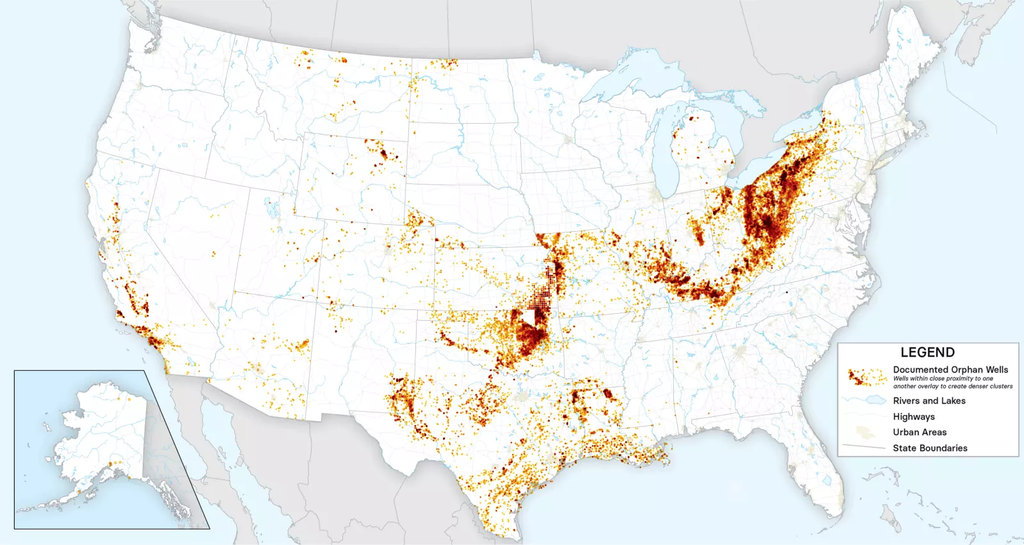
Documented orphaned wells in the United States as of 2021, according to the Environmental Defense Fund.
The Economic, Environmental, and Health Impacts of Orphaned and Abandoned Wells
Orphaned and abandoned wells are associated with compounding negative impacts for health, the environment, and taxpayers.
Because orphaned and abandoned wells are, essentially, very deep holes in the ground that are not properly maintained, they may create a shortcut between substances deep underground and the air, water, and land we rely on. Unplugged wells can spew methane and carcinogenic volatile organic compounds (VOCs) into the air above, leach arsenic and other metals into the soil and groundwater below, and even explode due to a buildup of gas, posing long-term environmental, health, and safety concerns. These threats are particularly acute for neighboring homes, schools, and communities, as well as for the people who own the land the abandoned or orphaned wells are on but not the wells themselves, and who may face depreciated land values as a result.
States generally become the pluggers of last resort for every well that slides from abandoned to orphaned, often at taxpayers’ expense. However, the number and cost of orphaned wells that states need to plug often dwarfs their allocated budgets to do so. For example, Pennsylvania used federal funding to significantly increase the number of orphaned and abandoned wells it plugs, plugging 300 in two years—but it still faces a backlog of more than 27,000 wells. New Mexican taxpayers face a similar to-do list.
Shareholders in oil and gas companies also face risk when it comes to unplugged wells, as they may be uninformed of the total sum of well-plugging liabilities a company has on its books and may be unprepared for the costs of enforcement action.
If abandoned and orphaned wells are so bad, why do they exist? While we will explore some of the complexities below, let’s start with the simple explanation: abandoned and orphaned wells exist because their operators did not plug them. Behind every abandoned and orphaned well, there is at least one operator that should have plugged it, but did not.
So perhaps the better question is, how do operators get away with it? One answer lies in the difference between how oil and gas well regulation works in theory and how it works in practice.
The System in Theory: The Platonic Ideal of Oil and Gas Well Regulation
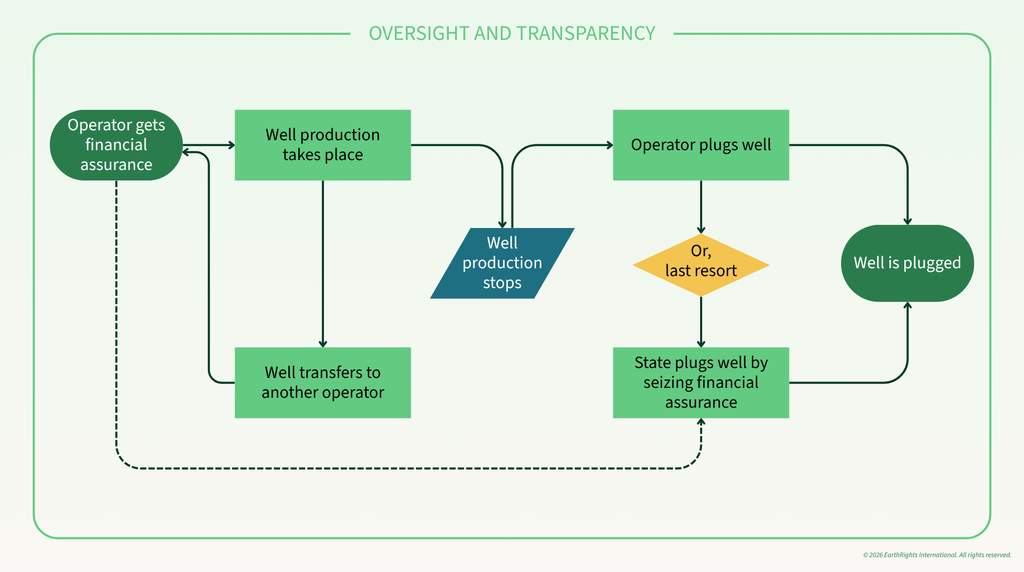
Oil and gas well regulation, as it works in theory.
In an ideal world, oil and gas well operators would ensure that non-producing wells are plugged as a standard part of their business model, and regulators would conduct enforcement actions in the isolated cases where the rules are not followed. A simplified story of a well’s life in such a system might look like the following—and in fact, most states have regulations on the books that broadly follow these contours:
- Financial assurance: Operators have to apply for and receive a permit for each well that they operate. In order to receive a permit for the well, the operator has to post financial assurance, often in the form of a bond. This bond ensures that there are sufficient funds set aside for the state to carry out cleanup if the company abandons or orphans the well.
- Production: Operators produce oil, gas, or other products from their well, and make money by selling those products.
- Transfers: Operators may decide to transfer (buy or sell the right to operate) wells at various stages in a well’s productive life. New operators must be approved by the regulator and post financial assurance.
- Plugging: Once a well is finished producing, the operator plugs the well and cleans up the area. If the operator doesn’t plug the well, the state or federal regulator seizes the financial assurance and uses it to pay for plugging the well and related cleanup.
Throughout this lifecycle, wells and their operators are continuously subject to:
- Oversight: If any wrongdoing takes place, the state or federal regulator has the mandate and resources to identify it and pursue enforcement.
- Transparency: Operators regularly share information about well production, leaks and spills, and safety incidents with the regulator, and the regulator shares information about wells, operators, and their activities with the public.
The System in Practice: Regular Operator Evasion and Regulatory Failure
In practice, oil and gas well operators frequently deploy a range of tactics to dodge their plugging obligations, and government regulations and enforcement often fall far short of what is needed to hold companies to account.
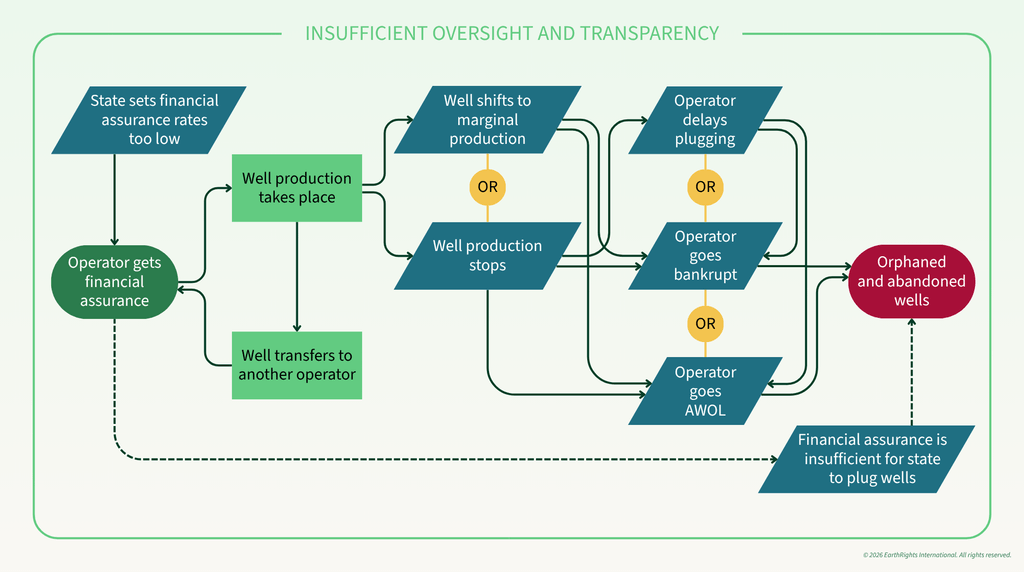
Oil and gas well regulation, as it generally works in practice.
Operator Evasion
Even though regulators generally have rules in place that mandate well plugging after a period of non-production, operators often delay or shift the burden of plugging through a combination of three tactics: delay, transfer, and disappear.
- Delay: Oil and gas well operators may use deferral and minimal production to push off requirements to plug their wells, even if the wells are effectively non-producing or marginal and may cause harm to communities.
In many states, operators can apply for permits to pause production on their wells without triggering the requirement to plug nonproducing wells, or they can postpone plugging obligations entirely. In Texas, well operators can defer well plugging for up to 15 years of inactivity. In certain cases, state regulators have also come to agreements with delinquent operators that allow them to plug at much slower rates than would normally be required.
Operators may sometimes also avoid plugging wells by producing marginal (very low) amounts of oil or gas from virtually spent wells. Even if marginal well production is not financially lucrative, at times it can help operators avoid the larger cost of plugging the well. Marginal well production can also come with tax advantages, subsidizing operations.
When implemented, delay tactics mean that any environmental and health harms hurt the community for longer, and that operators have more time to avoid accountability and abandon or orphan wells.
- Transfer: Well operators may transfer (sell the rights to operate) wells that are no longer profitable. Operators may do so to avoid plugging requirements, and may transfer wells to risky companies or to shell companies within their corporate network that then go bankrupt. While a transfer likely means a new operator is responsible for plugging, transfers are associated with a higher likelihood of well abandonment or orphaning. Receiving operators may not always be aware that they are receiving wells that will cost more than they make, they may rely on regulators not enforcing plugging requirements, or they may have been established for the very purpose of accepting spent wells and then declaring bankruptcy.
- Disappear: Oil and gas well operators may also disappear—either officially through bankruptcy, for example, or through a slow fade into inaction—leaving abandoned and orphaned wells in the hands of a regulator.
Operator bankruptcy often results in orphaned wells. In some situations, the operator may have simply made and spent its money, with nothing left over to continue operations and pay for liabilities, including unplugged wells. In other cases, oil and gas operators appear to intentionally siphon away money before declaring bankruptcy.
As some operators deploy marginal production, transfers, and bankruptcy to avoid well plugging, other operators take the easiest route:: they do nothing. Some operators with wells due to be plugged have other active production and corporate activity, but seem to willfully ignore their well plugging obligations. Other operators appear to disappear entirely, ceasing all reporting to their regulator but not officially going bankrupt.
Regulatory Failure
Regulations and enforcement fall far short of what is needed to enforce operator plugging and other cleanup obligations. Three key failures across many regulatory regimes include:
- Insufficient Financial Assurance: Required financial assurance, usually in the form of a bonding rate, is almost always too low to cover the actual cost of plugging the well and remediating the well location. For example, in West Virginia, conventional well bonds are set at $5,000. This amount is dwarfed by the average $120,000 that West Virginia spends plugging a single conventional well; even the most conservative estimates of plugging costs are between $30,000 to $60,000. And these plugging costs don’t even include the additional cost of environmental remediation at the well sites. Low bonding rates are exacerbated by the use of “blanket bonds,” or bonds that cover multiple wells, and which cost less per well than a single bond.
Low bonding rates hurt taxpayers. If and when states seize the insufficient bonds to address orphaned wells, they need to supplement them with taxpayer money to actually plug the wells and carry out remediation. Low bonding rates are a form of hidden subsidy that allows oil and gas well operators, as well as the insurers behind them, to avoid accounting for the full cost of plugging wells and remediating well locations throughout their lifetime.
- Enforcement: Regulators across the country have inadequate resources and mandates to identify and enforce rulebreaking. For example, the Ohio River Valley Institute reported that West Virginia has one inspector for every 6,700 wells, with inspections and enforcement actions in decline since the 1980s. Furthermore, regulators do not always enforce existing laws against delinquent operators. Over the past several years, landowners, concerned citizens, and environmental groups have brought cases against regulators in California, Ohio, New Mexico, Pennsylvania, as well as at the federal level, for not fulfilling their regulatory obligations. (Note that EarthRights serves as legal counsel in one of these cases in New Mexico.)
Low financial assurance also has an impact on enforcement. In some states, the bonding rates are so low that it may not be worthwhile for the state to call in the bond if the operator fails to plug, rendering a potential enforcement tool useless. In Pennsylvania, the state legislature set the bonding rate for conventional wells at $2,500 per well, leading the state’s enforcement agency to deprioritize claiming bonds.
Regulatory agencies may not even have the tools they need to address the most common methods through which wells are abandoned and orphaned. While regulators have the authority to approve or deny transfer requests, many choose to rubber stamp transfers, or don’t have the authority to evaluate the receiving operators’ record or financial ability to plug wells and remediate well locations.
- Transparency: Public understanding of how oil and gas wells and their operators might be impacting communities is dependent on accurate reporting from both operators and regulators. However, some regulators and operators fall far short of the mark. States like New Mexico and California have detailed and downloadable records about well ownership and production, but states such as North Dakota have sparse ownership records and no production data. Other states, such as Texas and Oklahoma, have data stored in partially handwritten documents, making analysis difficult at any level of scale.
However, even when states publish transparent and accessible data, there is the risk that this data falls far short of the full picture. A 2022 Pennsylvania regulator report found that annually, about 60 percent of operators did not submit production, waste, and mechanical integrity reporting as required. In 2024, Colorado’s regulator found that operators and their contractors had submitted falsified pollution data about hundreds of wells. There is also evidence of recurring gaps and inconsistencies in operator self-reporting in New Mexico.
Plugging Wells Requires Corporate Accountability
Cleaning up after yourself is a basic principle that should apply across industry and elementary schools alike. Many players in the oil and gas industry, however, have gone to extreme lengths to pass the buck and push the economic and health burdens of plugging spent wells onto taxpayers and communities. The lax laws, regulations, and enforcement that contribute to this problem are often by design—many are a result of the industry’s lobbying efforts. The result is that the industry receives a hidden subsidy that further distorts markets and imposes additional hardship on taxpayers and communities.
To encourage more responsible well plugging, legislators, regulators, advocates, communities, and, yes, even companies, need to:
- Pass legislation and regulations that require sufficient financial assurance for well cleanup and address other evasion tactics and risk factors for non-plugging;
- Fully fund, adhere to, and enforce existing and new regulations to ensure operators plug wells and remediate well locations, including through civil and criminal cases;
- Identify and pursue accountability actions against the operators currently taking advantage of taxpayers and communities by evading their well plugging responsibilities.